









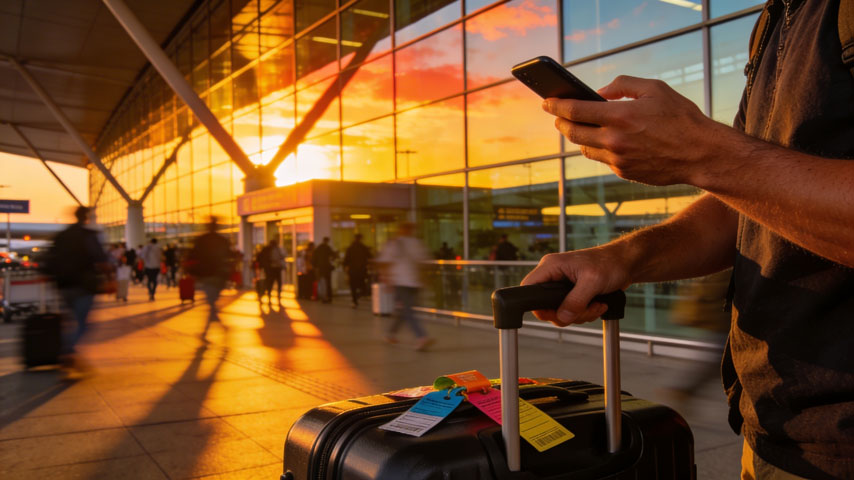
Not so long ago, Aussies travelling overseas were at the mercy of inconvenient local SIMs and eye-wateringly pricey global roaming rorts. But that all changed with the arrival of the eSIM, a high-tech, hassle-free alternative that’s transformed how we connect while abroad.
Keep reading to learn about all things eSIM, from comparisons to compatibility and common problems.
WHAT IS A TRAVEL eSIM?
An eSIM (embedded SIM) is a permanent, programmable chip inside your phone measuring about 5x5mm. Through it, you can download and install SIM software straight onto your device. Instead of communicating with a tiny microchip implanted in a plastic SIM card, your phone accesses all the necessary network information via a digital SIM profile.
The travel eSIM is specifically designed for international travellers, offering a convenient, affordable alternative to local SIMs and roaming. Most cover data only, though a select few include talk and text.
HOW TRAVEL ESIMS WORK
With regular SIMs, you have to purchase a physical card from a brick-and-mortar store, carefully install it into a teeny-weeny SIM tray, choose a suitable plan, provide photo ID, and activate your account.
eSIMs work differently. You purchase a plan on your provider’s website and download it through a QR code or mobile app. That’s it. Upon arriving at your destination, the travel eSIM will activate automatically. Expect a connection as soon as you step off the tarmac.
From a technical perspective, eSIM providers negotiate deals with overseas telecommunications networks, allowing customers to use a set amount of data for a specified fee. Remote SIM provisioning (RSP) allows the over-the-air (OTA) transfer of operator credentials, enabling eSIMS to authenticate and access partner networks.
WHY TRAVELLERS ARE SWITCHING TO ESIMS
eSIMs offer heaps of benefits, prompting many savvy Aussie travellers to make the switch.
CONVENIENCE
eSIMs make getting connected easy. No juggling tiny plastic SIM cards, queueing at a kiosk, or battling the language barrier just to get data. You purchase a plan online and install it.
AFFORDABLE
The cheapest eSIM plans offer low rates that won’t break the bank. Even the premium providers work out way cheaper than most global roaming charges.
USER-FRIENDLY
While they sound kind of techie, eSIMs are so simple even grandma could work them out. The online installation process takes less than 5 minutes from start to finish.
INSTANT ACTIVATION
Well-organised travellers who pre-purchased their eSIM will see it spring into action upon touching down at the airport. When purchasing an eSIM overseas, your data plan will activate upon installation.
MULTI-SIM MANAGEMENT
Most modern smartphones support two active eSIM plans simultaneously, allowing you to switch between them. Devices can usually store multiple inactive plans, and you can keep your physical SIM on standby – essential for two-factor authentication SMS.
FLEXIBLE COVERAGE
The best eSIM providers for Aussies sell single-country plans, regional plans (i.e., Asia or Europe), and global plans covering most nations.
ENVIRONMENTALLY-FRIENDLY
eSIMs don’t generate waste. Plastic SIM cards, on the other hand, come with microchips made from rare earth metals and a handful of non-biodegradable packaging.
SECURITY
Lost your phone on a bender in Berlin? No worries. You can regain access to your data plan through the provider's website. We can’t say the same about your device, though.
ESIM VS INTERNATIONAL ROAMING
We won’t try to BS you. Global roaming wins when it comes to convenience.
Some Aussie telcos, such as Vodafone, don’t make you do anything. Vodafone automatically switches eligible customers to global roaming, letting them use existing data for $5 extra per day.
While this “cost-of-a-cup-of-coffee” offer sounds good, it works out to $75 per fortnight, or a whopping A$150 per month. That’s waaay more than even the exxiest eSIM plan. Plus, you’ve got eligibility requirements, excess data charges, and hotspot limits to worry about.
For comparison, ZenSim offers 30-day packages to Australia’s favourite Southeast Asian getaway, Bali, from just A$21. Even power users on an unlimited plan will spend only A$79 per 30-day period.
Roaming can work well for Aussies on a quick overseas trip, staying a few days or so. But for longer jaunts, the eSIM makes more financial sense.
By the way, Vodafone’s $5 per-day deal is one of the “best value” global roaming offers for Australians. You don’t even want to know what some competitors are asking.
ESIM VS PHYSICAL SIM CARDS
Physical SIM cards purchased in-country can potentially offer lower prices than eSIMs.
But it depends on where you buy them. Pick up a plan from an overpriced airport kiosk, and you might not save any money. The same goes for rip-off street merchants at Australia’s favourite Southeast Asian holiday destination (not naming any names).
If you do find a cheaper SIM locally, it’ll could save you a few bucks – and that comes at the cost of convenience. Setting up a local SIM requires finding a trustworthy retailer, queuing for service, selecting a plan while wrestling with the language barrier, handing over sensitive personal information (passport), and waiting for the vendor to configure your plan.
The whole rigmarole can take up hours on the first day of your holiday. Is that really worth it for such a meager saving? Physical SIMs mostly win out for travellers on longer stays in one country, typically multiple months.
Some other huge benefits of buying a travel eSIM are being able to compare prices, look at the reviews of your potential provider and be able to access customer service online any time of day.
ESIM VS POCKET WIFI
The pocket WiFi is a small, portable router that captures a signal from nearby towers and transmits it as WiFi. Most travellers rent a pocket WiFi through agencies like Klook, collecting it from the airport or their hotel upon arrival.
This approach requires a bit of legwork, as you need to organise a time and place to pick up the device and return it. You must also ensure the device is charged up, not easy when a typical battery life is between 5 and 12 hours. Of course, as the contract signer, you’ll be liable should the unit get lost or damaged.
Pocket WiFi makes more sense for larger groups, as everyone can share one connection. But should the device-carrier wander off, the rest suddenly go offline – good luck finding each other without a signal. Plus, with eSIM plans so cheap these days, you might as well get a private connection.
WHERE TRAVEL ESIMS WORK BEST
Roaming appeals to cashed-up holidaymakers on a quick overseas trip. Physical SIMs might save some money for budget-conscious long-stayers living in one country. The eSIM? It sits somewhere in between.
Travel eSIMs hit the sweet spot for convenience and cost on standard holidays, anywhere between one and eight weeks. You also get great value on longer multi-national trips, as you don’t need to set up a connection in each new country. Look for regional plans, like Asia eSIMs or Europe eSIMs, or choose a Global eSIM plan for a seamless connection if you’re doing an epic round-the-world adventure.
WHICH PHONES SUPPORT TRAVEL ESIMS?
Most modern smartphones accept eSIMs. From around 2018 to 2021, only top-tier flagship phones were eSIM compatible as the tech was still fairly niche. Nowadays, most recently-made mid-range and even low-end smartphones support the technology.
The easiest way to confirm yours is to use our eSIM compatibility checker. In addition to supporting eSIMs, your phone must not be locked to a specific carrier.
ZenSim has a super flex money back guarantee so if you do purchase one and later realise your phone is locked or unable to use the eSIM, they will refund you so no worries there.
HOW MUCH DATA DO YOU NEED FOR TRAVEL?
Data usage varies significantly between people. Frugal data savers could last a week with 3GB, while a TikTok addict might churn through 10GB+ in that time.
When exercising mild restraint, most Aussie travellers feel 20GB per month does the job. Light, intermittent users can usually get away with 10GB. Screen addicts and hotspotting remote workers might prefer an unlimited plan. Remember that “unlimited” actually has a daily limit, usually 3-5GB, after which the speed gets throttled.
Here are a few tips to help you minimise data use while on the road.
- Save big downloads and doomscrolling for the hotel WiFi
- Disable automatic updates through your cellular data
- Download your maps for offline use
- Turn off data-hungry background apps like iCloud Drive or Google Sync
HOW TO INSTALL AND ACTIVATE AN ESIM
We can’t speak for all providers, but getting set up with ZenSim is a cinch. Here’s a quick, simple walkthrough.
- Choose a suitable travel eSIM for your trip and purchase the plan.
- Scan the QR code with your camera and tap the “Data Plan” notification.
- iPhone users can also use the ZenSim app for one click installation.
- Follow the instructions to install your new data plan; the default settings will usually do.
- Ensure that data roaming is enabled for your eSIM.
- Upon arrival, iPhone users must manually turn on mobile data for the eSIM plan.
- Enjoy a speedy, seamless connection during your holiday.
For more details, see our eSIM installation guide.
TIPS FOR USING A TRAVEL ESIM ABROAD
Keen to give the tech a crack? Follow these tips and learn how to use your eSIM abroad like a boss.
- Check your phone for eSIM compatibility before purchasing a plan.
- Ensure your destinations are covered under (a Europe plan won’t necessarily include all European countries).
- Install your eSIM at home before you go.
- Set data to run from your eSIM as soon as you land.
- Log onto your hotel WiFi to reduce data usage throughout your trip.
- Use the ZenSim app to monitor consumption or make top-ups where required.
- Keep your home SIM active to receive two-factor authentication SMS codes.
- Disable roaming on your home SIM to avoid nasty, unwanted charges.
ARE TRAVEL ESIMS SAFE TO USE?
Travel eSIMs are the safest way to stay connected abroad.
While eSIMs offer a secure, private connection, public WiFi is vulnerable to hackers on the same network. With physical SIMs, you risk getting locked out of your account should you lose your phone, whereas eSIMs let you jump back in with another device.
Global roaming, while quite safe, has a bad habit of giving customers bill shock. Unwitting travellers often come home to a soul-crushing bill. eSIMs work on a prepaid basis so you can't overspend.
Travel cybersecurity best practices include using a VPN for sensitive websites (i.e., banking), updating your OS and apps, and sticking to reputable eSIM brands.
COMMON TRAVEL ESIM PROBLEMS AND HOW TO FIX THEM
While eSIMs are designed to be easy to use, issues can arise from time to time.
Here are some common problems and possible solutions. For ZenSim-specific technical help, see our eSIM troubleshooting guide.
NO DATA CONNECTION
eSIMs work through global roaming, so ensure roaming is enabled on your eSIM. Also, check that your device is using the eSIM connection for mobile data.
Have you tried turning it off and on again? Switching on aeroplane mode for 30 seconds, then turning it off, and/or restarting your phone, can help the system recognise a new connection.
ESIM NOT ACTIVATING OR INSTALLING
Ensure your WiFi connection is stable using a speed check. Review whether your phone is compatible with an eSIM.
Delete the eSIM profile, restart the phone, and scan the QR code again to reinstall the eSIM.
SLOW SPEEDS
Open the app to review your data usage. Unlimited plans have daily limits; once you exceed them, your speed is throttled. Move outside or to higher ground if possible to obtain a better signal.
Some travel eSIMs connect to lower-tier networks with lacklustre speeds.
CHOOSING THE BEST TRAVEL ESIM FOR YOUR TRIP
The best eSIM for Aussies travelling overseas depends on your preferences. Some providers, such as Holafly, specialise in unlimited plans for heavy users, while others, like Saily, bundle NordVPN to strengthen security.
When comparing providers, travellers should weigh up various factors.
- Duration: Is the plan suitable for your trip length?
- Destinations: Are all the countries you want to visit covered?
- Data: Will the allocated limit align with your usage style?
- Flexibility: Can you top up data, extend the duration, or add new countries?
- Networks: Does your eSIM connect to high-quality local networks with broad coverage?
- Support: Will the provider respond promptly with helpful information?
- Simplicity: Is the product easy to install and activate?
- Price: How does the final price compare to competitors?
ZENSIM: THE GO-TO ESIM FOR AUSSIES TRAVELLING OVERSEAS
At ZenSim, we pride ourselves on providing Aussie globetrotters with top-tier service at a low-end price.
Despite being cheaper than many competitors in major markets like Japan, the Phillipines, America, and New Zealand, ZenSim partners with top local networks to ensure speedy, low-latency connections.
Our 10-day and 30-day plans cater to light, moderate, and heavy users, offering flexible top-up options to add extra data, days, or destinations. Australia-based support responds promptly through WhatsApp, not that you’ll likely need it, given our eSIMs are a cinch to use and install.
Give our travel eSIMs a crack and see why we’ve got an average ProductReview rating of 4.9 stars.


Written by Andy Linton
Co-founder of ZenSim, loves a bit of Star Wars.
Andy has been in the telecommunications industry for the better part of 20 years. Somewhat of a super-nerd, Andy is the co-founder of ZenSim and the maestro behind the systems we use to provide our services.
Let's connect on LinkedIn 👉

Get amongst it
Join the community
We will reach out when we launch new products, about our sustainability projects, specials, new innovations or maybe even cool sh*t we think is inbox worthy.


